Training the Brain

Say you’re at a cocktail party, crowded restaurant or concert. Have you wondered how you are able to filter out noises and focus your attention on conversations or listen for specific sounds?

Say you’re at a cocktail party, crowded restaurant or concert. Have you wondered how you are able to filter out noises and focus your attention on conversations or listen for specific sounds?

As proven by the World Cup or the Olympics, sports and identity are often expressed and encoded in signs and symbols that represent race, sex, politics, nations, regions and cultures, providing opportunities for support and acceptance, conflict and strife.
Film industry trade publication The Hollywood Reporter has ranked the Department of Radio-Television-Film 10th in their list of the top 25 film schools in the United States.
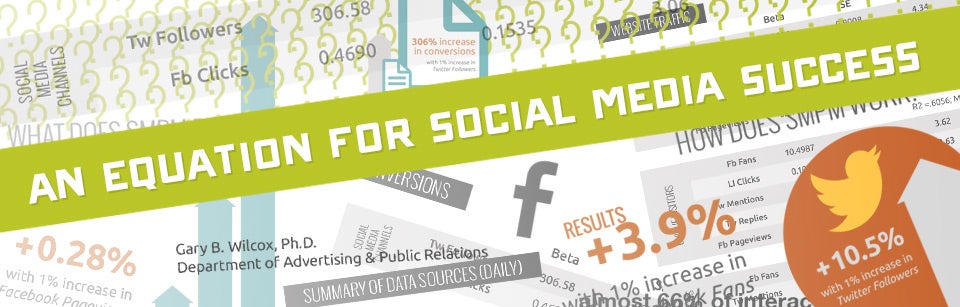
As the number of "chief data officers" grows and organizations try to analyze an increasing amount of online data, University of Texas at Austin researchers have created a statistical model that measures the ROI of social media efforts.

From humble beginnings sweeping the floor of broadcast news television studio KOCO-TV in Oklahoma City following his graduation from the Department of Radio-Television-Film to his rise as one of television’s iconic producers, Bill Geddie (B.S. ’77) never forgot his time on the Forty Acres.
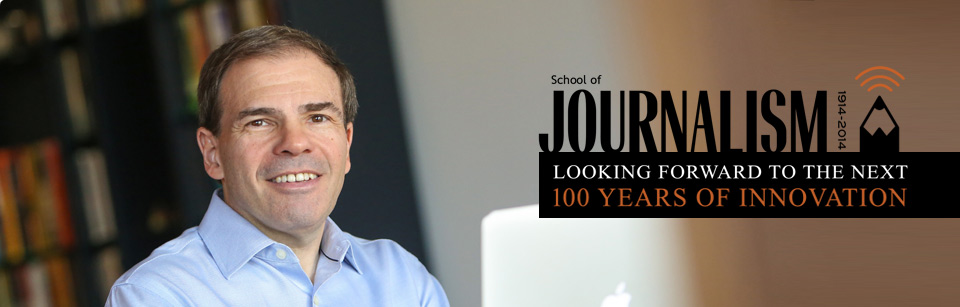
The School of Journalism is in the midst of its centennial this year and will launch the next 100 years with new chair R.B. Brenner, a former Washington Post editor and award-winning journalist.
This is one honor that’s not up for debate. The University of Texas at Austin speech and debate teams have won the 2014 American Forensic Association’s top overall prize, a distinction they now have claimed 19 times since the award began in 1993 — more than any other university.
Do companies and organizations focus on the wrong outcomes when using social media? According to public relations alumna Deirdre Walsh (B.S., '02), senior social strategist at Jive Software, companies should go beyond amassing likes and followers and examine the fundamental ways in which social media can alter their business.
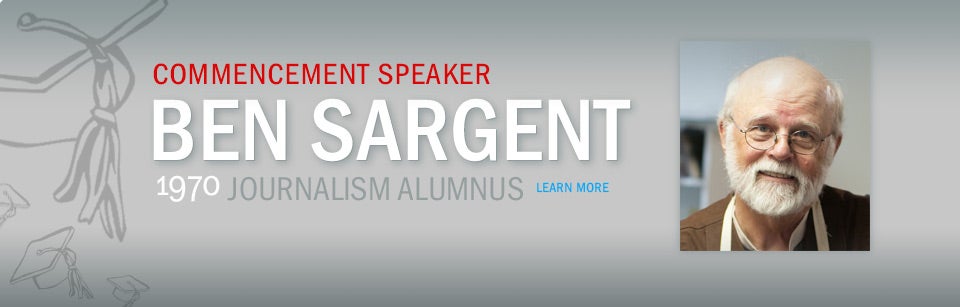
Ben Sargent (B.J. ’70) was born into a newspaper family in 1948. As a sixth-generation Texan and native of Amarillo, he started working for a local paper as a proof runner at the age of 14, delivering proofs of advertisements to neighborhood merchants for content approval. This modest beginning in journalism launched a career that would eventually garner decades of national attention, including the Pulitzer Prize.