
The ethics of AI: A Q&A with Craig Watkins
The ethics of AI: A Q&A with Craig Watkins
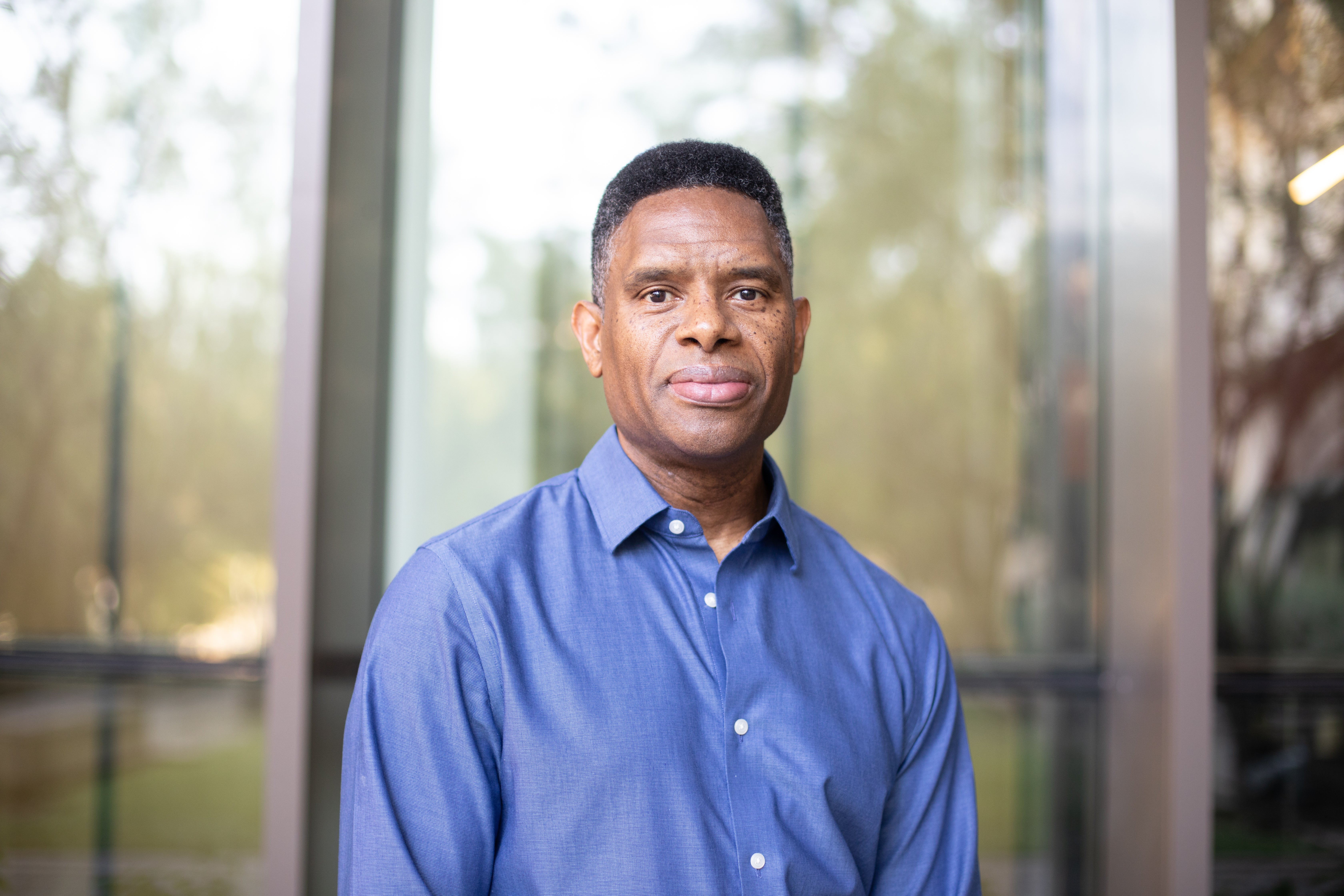
As artificial intelligence continues to make headlines worldwide, Moody College of Communication researchers are on the front lines of how this technology may affect various forms of communication and media. Craig Watkins is a professor in the Moody College’s School of Journalism and Media and the Department of Radio-Television-Film, and the executive director of the IC2 Institute at the University of Texas at Austin. He earned his Ph.D. in Sociology in Communication from the University of Michigan. A leading voice on the ethical implications of artificial intelligence, Watkins leads teams that study the impacts of computer-mediated technologies on society and is one of the principal investigators for UT Austin’s Good Systems Grand Challenge. He also serves on AI advisory boards for organizations such as Google, Google/DeepMind, Fathom and Scratch.
Learn more about his work and how he feels AI will continue to evolve and impact certain industries.
Your research focuses heavily on the ethical implications of AI. Can you give us an explanation of what that means?
As AI becomes increasingly more powerful and capable in terms of the things that it can do, things that not too long ago we thought only humans could do, it raises ethical questions like ‘Are we designing these systems in ways that are safe for humans?’ In terms of national security, job security, economic opportunity and environmental safety as well. The ethics of AI have to do with technology that has unprecedented power, and working towards harnessing and controlling that power to ensure that it does good and has a positive impact on the world rather than a negative impact.
How did you get started in this type of research?
I’ve always been interested in the intersection of humans and technology throughout my academic career. Technology has evolved over the years, whether that be the internet, social media or smartphones. It has been a natural progression of technological advancements, and AI is the most recent and, in some ways, most significant development. We started looking at AI about eight years ago, in terms of trying to understand the broader societal implications of this technology, as it was rapidly evolving and taking on more and more capabilities. We were focused on learning how humans will learn to interact with this system, and what will be required of humans to control and develop these technologies that could possibly advance humanity.
There’s a lot of discourse in the media surrounding AI. In your research, what have you found to be one of the most prominent ethical implications of it?
I think now, what we are seeing in terms of developments in AI on the research side, and the various frontier labs that are building this technology, we are seeing an exponential curve in terms of its capabilities. Four years ago, everyone was fascinated by chatbots that you could type something into and they could respond instantly. That was remarkable. Here we are four years later, and we are looking at technology that is radically different. AI agents can act autonomously, they don’t need you to prompt back and forth. We are learning that as these systems become more and more capable, they are also providing evidence that they can develop their own goals that may or may not align with the goals of the organization, the institution or society. That’s where the friction and tension between them begin to merge around systems that have the ability to do things that we don’t necessarily understand or can control, in terms of making decisions, accessing information and breaking into infrastructure. This can implement real security issues.
You are one of the PIs on UT’s Good Systems Grand Challenge. Can you explain what Good Systems is?
Good Systems is one of three main challenges here at UT. Good Systems is a reference to what is oftentimes referred to as what is “ethical” or “responsible” AI. Good Systems was started with the premise that since AI is becoming so prominent and spread throughout society, questions beyond those that are just technical are being raised. When you start deploring AI into healthcare, education, criminal justice, finance, you start getting into non-technical issues. Ethical issues, social issues, issues around fairness, how society will be impacted. Good Systems was created specifically to bring together multi-disciplinary expertise. Not only from computer science, not just engineering, but also from social science, humanities, ethics, philosophy and communications. Good Systems is an interesting enterprise because it represents the need to bring in different kinds of voices and expertise to start thinking expansively about this technology in ways that no one could have ever predicted.
What is the IC2 Institute about?
IC2 has been around for a number of years. It's an institution that reports directly to the vice president of research. Under my leadership, IC2 has really been focused on the intersection of AI and society, with a specific focus on health, healthcare and medicine. We are partnering with a number of different entities including Dell Medical School, various researchers and principal investigators across campus and beyond. We are really trying to grapple with one of the interesting challenges that is emerging, which is deploring AI in a high-stakes environment such as health and medicine.
"Some of the evidence that we are seeing is the ability to use these technologies to deepen and expand these skills rather than replacing them. That’s going to be really critical. Developing a degree of agency and intuition about how these technologies work, and how they can work in a way to enhance your abilities to think creatively, problem-solve, and to maintain some degree of authoritative agency in whatever your field may be."
What are some privacy concerns with using AI in the healthcare field?
Privacy issues in terms of AI in healthcare are substantial. AI is, more than anything, predicated on amassing significant amounts of data and information in order to train models to make a prediction about disease or recovery from a surgery, or who’s at risk for certain diseases. All of that requires access to data in order to understand patterns, what combination of variables and factors are likely to be predicted with a different outcome, and how do you identify those things early rather than later in order to intervene. Because it is so data centric, it requires collecting very personal information about people. Health, behavior, medical data, medical records, which are all very sensitive. It’s the need to develop the capacity to refine these technologies in ways that can help you be predictive, intervene, understand health patterns, and create mechanisms to address them. How do you do that safely, ethically, and in ways that don’t violate people’s personal data? There’s a lot at stake in terms of how personal data can be commodified in ways that we aren’t aware of. It raises significant issues about privacy and about data security, and how our information is being used. Most people would be okay with their information being used to serve them, and if it could serve others, great, but if it's used to target people with products, used to make you feel anxious, or determined to make people use a piece of technology, I think that’s where people could get concerned.
Generative AI is growing so rapidly. What does this mean for the future of AI in general?
In terms of the exponential curve that Ai is on, in terms of its progression regarding its capacity to do things we never could’ve imagined, to organize, to coordinate, to synthesize, to plan, to act autonomously. The honest answer to what the future holds, is that we don’t know. This is both unnerving and exciting at the same time. If you can harness that in ways that transform medicine, enable us to eradicate diseases or come up with solutions to diseases, improve biotech and develop new medicines, new ways to advance people’s expertise and capacity, to perform their jobs at higher, more expert levels, that would be great and significant. But there’s also potential for the opposite to happen. This technology could be harnessed in ways that vast members of the world are unemployable and wealth gaps could become apparent. The reality is that because this technology is accelerating at such a rate that we just can’t understand, the industry is recognizing the need to slow things down. The idea is that there is an increasing recognition that we are building something that we don’t fully understand. If you don’t fully understand it, the ability to harness it, control it, and use it in positive ways becomes much more doubtful.
How does it feel to be able to lend your expertise to prestigious organizations and boards?
It’s rewarding to know that the work that I and my team have been doing over the years is valued. I think we are asking the right questions at the right time. These are questions that other organizations are trying to solve. These organizations are either in the middle of building this technology, or in the middle of trying to understand what these technologies mean for different parts of the population. This is unlike anything we have ever seen before, and it requires a degree of urgency, study and expertise that we bring to the conversation. It reinforces what we suspected, that these are critical questions that have broad societal impact. Working with these organizations to help them think ethically about how they are building technology and help them think about ways they should be studying this technology in order to inform educators and policymakers, in order to design curriculum and what the future of work might look like. These are substantial questions for society, and we are pleased to be involved in those conversations.
What would be your advice to students and consumers on how to use AI ethically and for good?
For students, as they begin to ponder what our future looks like, as technology begins to become able to do what an entry-level college graduate might do, a question increases for them, and for all of us, is what skills can you develop that are separate from what machine intelligence can do? How do you cultivate those skills? What are those skills? Some of the evidence that we are seeing is the ability to use these technologies to deepen and expand these skills rather than replacing them. That’s going to be really critical. Developing a degree of agency and intuition about how these technologies work, and how they can work in a way to enhance your abilities to think creatively, problem-solve, and to maintain some degree of authoritative agency in whatever your field may be. There is a future there, in terms of what this technology may present from an employment perspective. The question becomes, what are those skills? Who develops those skills and what are the means by which they get developed.
